The Hidden Costs of Email Marketing Tools in 2026: What Nobody Tells You Before You Subscribe
Why this article exists
Every email marketing tool advertises a clean, low starting price. ActiveCampaign: "from $29/mo." HubSpot: "Free CRM." Mailchimp: "from $13/mo." ConvertKit: "from $9/mo." These prices are real — for the smallest possible plan, with the smallest possible contact list, missing the features you'll actually need.
We spent three months analyzing the actual costs our users report across Reddit, G2, and Trustpilot. The patterns are consistent: the advertised price is 40-70% of what you'll actually pay once you factor in contact growth, feature upgrades, add-ons, and the billing practices each platform doesn't mention upfront.
This is not a sponsored comparison. We have affiliate relationships with some tools mentioned, but our analysis is based on publicly available pricing pages and real user cost reports. Here's what we found.
The contact-count pricing trap
The fundamental pricing model of email marketing is designed to scale against you. Most tools charge by the number of contacts in your database, not the number of emails you send. This creates a perverse incentive: your costs increase as your audience grows, regardless of how much you actually use the tool.
Here's what that looks like in practice:
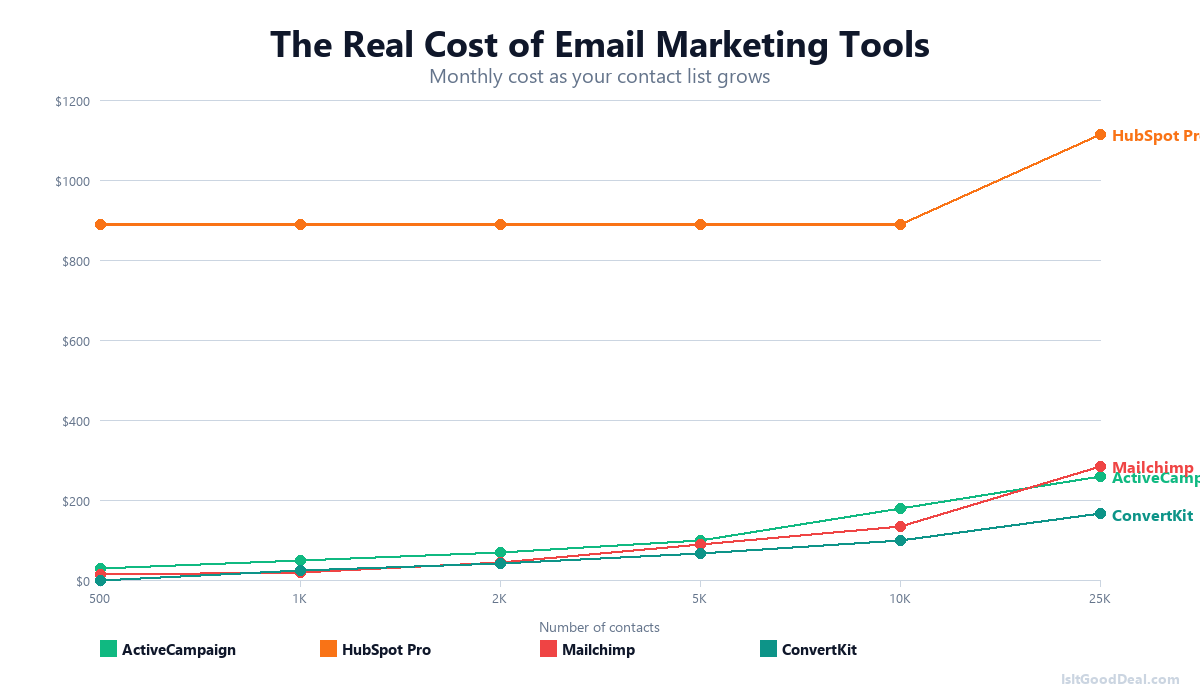
- At 500 contacts: Most tools cost $13-29/month. Manageable.
- At 5,000 contacts: Mailchimp Standard jumps to $90/month. ActiveCampaign Plus is ~$99/month. The gap narrows.
- At 25,000 contacts: Mailchimp Standard hits $285/month. ActiveCampaign Plus is ~$259/month. HubSpot Professional is still $890/month but now looks relatively less insane because you'd need it.
The exception is Brevo (formerly Sendinblue), which charges by emails sent instead of contacts stored. If you have a large list but send infrequently, Brevo can be 60-80% cheaper. We don't have a full verdict on Brevo yet, but it's worth considering as an alternative pricing model.
The other hidden element: most tools count inactive and unsubscribed contacts against your limit. Mailchimp is the worst offender — unsubscribed contacts count toward your billing threshold until you manually archive them. ActiveCampaign automatically excludes unsubscribed contacts from billing. This single difference can mean a 10-20% cost gap at scale.
ActiveCampaign: the automation king ($29-259/mo)
ActiveCampaign is the tool most frequently recommended on Reddit's r/emailmarketing and r/entrepreneur for a reason: it offers the most powerful automation at its price point, period. The visual workflow builder lets you create multi-step sequences with conditional logic, lead scoring, site tracking, and predictive sending — features that HubSpot locks behind its $890/month Professional plan.
What you actually pay
- Lite ($29/mo, 1K contacts): Email marketing, automation, inline forms. Solid for solo operators.
- Plus ($49/mo, 1K contacts): Adds CRM, lead scoring, landing pages, SMS. The sweet spot for most businesses.
- Professional ($149/mo, 1K contacts): Adds predictive sending, split automation, site messaging.
- Enterprise ($259/mo, 1K contacts): Custom objects, HIPAA, dedicated account rep.
The hidden costs
- Contact scaling: Add $20-30/month per additional 1K contacts on Plus. At 10K contacts, Plus costs ~$180/month.
- SMS credits: Sold separately. Not cheap — $0.015-0.05 per message depending on country.
- CRM is Plus-only: If you need the CRM pipeline (and you probably do), the real starting price is $49, not $29.
What users actually say
G2 rates ActiveCampaign 4.5/5 overall with 4.7/5 specifically for automation. The most common praise: "replaced 3 tools with one." The most common complaint: the interface feels dated compared to newer tools, and the learning curve is steeper than Mailchimp. Trustpilot reviews are mixed (3.4/5), with most negative reviews citing billing issues after plan changes — a pattern across all email tools, not specific to ActiveCampaign.

HubSpot: the free plan deception ($0-890/mo)
HubSpot's marketing strategy is brilliant and worth understanding because it directly affects your wallet. The free CRM is genuinely excellent — contact management, 2,000 emails/month, forms, live chat, basic reporting. No time limit, no credit card required. It's the best free tier in the industry and it's not close.
The deception isn't in the free plan itself. It's in what happens when you outgrow it.
The pricing cliff
- Free: $0. Genuinely useful. 2,000 emails/month, 100 contacts for marketing tools.
- Starter ($20/mo): 1,000 contacts, removes branding, basic automation. Fair price.
- CRM Suite Starter ($50/mo): All Hubs in Starter. Reasonable.
- Professional ($890/mo): 2,000 contacts, real automation, A/B tests, smart content. Annual commitment required. Plus mandatory onboarding fee ($3,000+).
Read that again: the jump from Starter to Professional is $20 to $890. There is nothing in between. This is the single most complained-about aspect of HubSpot across every review platform. G2 rates HubSpot 4.5/5 overall but only 3.8/5 on value for money.
The hidden costs nobody mentions
- Onboarding fee: $3,000+ for Professional, $6,000+ for Enterprise. Non-negotiable.
- Contact overages: Professional includes 2,000 marketing contacts. Additional contacts cost $225/month per 5,000.
- Add-ons: Transactional email, ads, dedicated IP, custom SSL — all extra.
- Seat costs: Sales Hub Professional is $90/user/month on top of Marketing Hub.
- Realistic year-one cost for Professional: $10,680 (subscription) + $3,000 (onboarding) + $900-2,700 (contact overages) = $14,580-16,380.
What users actually say
Reddit's r/smallbusiness and r/marketing are full of a specific narrative: "Started on the free plan, loved it, grew into Starter, then got quoted $890/month to do what ActiveCampaign does for $49." The ecosystem lock-in is real — by the time you've built workflows, trained your team, and integrated other tools, switching costs feel prohibitive. HubSpot knows this.

Mailchimp: death by a thousand fees ($0-350/mo)
Mailchimp's decline from "the default email tool" to "the tool you should probably switch away from" is one of the most documented stories in SaaS. The free plan was gutted in 2026 (250 contacts, 500 emails — essentially useless), prices have risen repeatedly, and the billing practices are genuinely hostile to growing businesses.
What you actually pay
- Free: 250 contacts, 500 emails. A demo, not a plan.
- Essentials ($13/mo, 500 contacts): Email scheduling, A/B testing, 3 audiences.
- Standard ($20/mo, 500 contacts): Multi-step automation, send time optimization, dynamic content.
- Premium ($350/mo, 10K contacts): Advanced segmentation, unlimited audiences, phone support.
The billing practices that make people leave
- Unsubscribed contacts count: You pay for contacts who opted out until you manually archive them. This is the #1 complaint on G2 (4.3/5 overall, 3.6/5 on value).
- Contact thresholds: Crossing 5,000 contacts on Standard jumps your bill from ~$50 to ~$90. No warning, no grace period.
- Feature creep pricing: Want to remove the Mailchimp footer? Paid plan. Want more than 1 audience on Free? Paid plan. Want automations beyond basic autoresponders? Standard or above.
- The intro discount trap: Many users sign up during a promotion (50% off for 3 months), then face full pricing with a bigger contact list than when they started.
What users actually say
Over 400,000 users have migrated away from Mailchimp since 2024, according to industry reports. The r/emailmarketing subreddit has a recurring "I just left Mailchimp" thread pattern. The most common destinations: ActiveCampaign (for automation), MailerLite (for a better free plan), and Brevo (for pricing-by-sends). EmailToolTester, an independent review site, dropped Mailchimp's rating to 2.9/5 — their lowest score for a major platform.

ConvertKit (Kit): the creator's choice ($0-50/mo)
ConvertKit — rebranded to "Kit" in 2024, though most users still call it ConvertKit — is the email platform built specifically for creators: bloggers, YouTubers, podcasters, course builders, and newsletter operators. It's not trying to be an all-in-one marketing platform. It does one thing well: help creators build and monetize an email audience.
What you actually pay
- Newsletter (Free, 10K subscribers): Landing pages, email broadcasts, digital product sales. Genuinely generous.
- Creator ($25/mo, 1K subscribers): Automation, sequences, third-party integrations.
- Creator Pro ($50/mo, 1K subscribers): Subscriber scoring, advanced reporting, referral system.
Why creators love it
- Free plan allows 10,000 subscribers — by far the most generous in the industry for list building.
- Built-in commerce: Sell digital products and paid newsletter subscriptions directly. No Shopify or Gumroad needed.
- Tag-based system: No "audiences" or "lists" that fragment your contacts and cost extra (looking at you, Mailchimp).
- Creator Network: Cross-promotion feature that helps you grow your list through other creators.
The limitations
- No real CRM: Contact management is basic. No deal pipeline, no sales tracking.
- Templates are minimal: By design — ConvertKit favors plain-text-looking emails for higher deliverability. But if you need beautiful HTML emails, look elsewhere.
- E-commerce integration is basic: Fine for digital products, weak for physical goods or complex funnels.

Head-to-head comparison: the honest table
| Criteria | ActiveCampaign | HubSpot | Mailchimp | ConvertKit |
|---|---|---|---|---|
| Real starting price | $49/mo (Plus) | $0 (Free CRM) | $20/mo (Standard) | $0 (Free, 10K subs) |
| Price at 5K contacts | ~$99/mo | $890/mo (Pro) | $90/mo | ~$66/mo |
| Price at 25K contacts | ~$259/mo | $890+/mo | $285/mo | ~$166/mo |
| Automation quality | Excellent (4.7/5) | Excellent (Pro only) | Basic | Good |
| CRM included | Plus plan+ | Free CRM | Basic | Minimal |
| Free plan value | 14-day trial only | Best free CRM | Nearly useless | 10K subs free |
| Billing transparency | Auto-excludes unsubs | Contact overages | Bills for unsubs | Clean tag system |
| Best for | SMBs needing automation | Teams needing all-in-one | Legacy users | Creators & newsletters |
| Deal Score | 7.8/10 | 6.8/10 | 5.8/10 | 7.8/10 |
The real cost at 1K, 5K, and 25K contacts
Forget the advertised prices. Here's what you'll actually pay at each stage of growth, assuming you need automation (the feature that separates professional email marketing from newsletter sending):
| Contact Count | ActiveCampaign Plus | HubSpot Pro | Mailchimp Standard | ConvertKit Creator |
|---|---|---|---|---|
| 1,000 | $49/mo | $890/mo | $20/mo | $25/mo |
| 5,000 | $99/mo | $890/mo | $90/mo | $66/mo |
| 10,000 | $180/mo | $890/mo | $135/mo | $100/mo |
| 25,000 | $259/mo | $1,115/mo | $285/mo | $166/mo |
| Year 1 total (5K) | $1,188 | $13,680+ | $1,080 | $792 |
The takeaway: At 1,000 contacts, the differences are small. At 5,000+, they become significant. HubSpot's Professional tier is 9-14x more expensive than the alternatives — justified only if you use the full CRM + sales + service ecosystem. Mailchimp appears competitive at low contact counts but scales worse than ActiveCampaign due to billing for inactive contacts.
Who actually wins? (It depends on you)
You're a solo creator or blogger
Winner: ConvertKit — The free plan with 10,000 subscribers is unmatched. Built-in commerce for digital products. Tag-based contacts mean you never pay for duplicate entries.
You're a small business needing automation
Winner: ActiveCampaign — Plus plan at $49/month gives you CRM + automation that HubSpot charges $890 for. The automation builder is best-in-class at this price point. Scales predictably.
You're a growing company with a $10K+ marketing budget
Winner: HubSpot — If you can afford Professional and will use the CRM + sales + service hubs, the ecosystem integration eliminates tool fragmentation. The free CRM as your starting point is the smartest play.
You're on Mailchimp and wondering if you should switch
Answer: probably yes — unless your integrations are deeply embedded and the migration cost exceeds the annual savings. Calculate your actual cost at current contact count vs. ActiveCampaign or ConvertKit. Most switchers report 20-50% savings with better features.
Our verdict
The email marketing tool market in 2026 has a clear hierarchy when you look at actual costs instead of advertised prices:
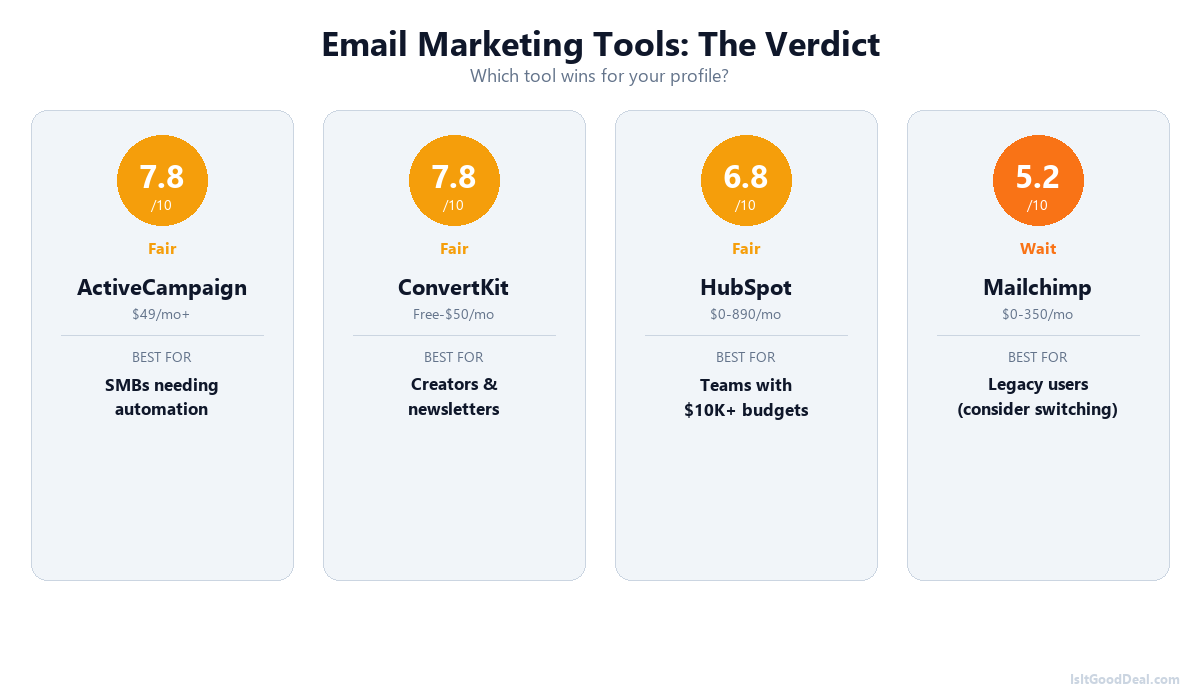
- ActiveCampaign (7.8/10) — Best overall value for businesses. Automation quality that punches way above its price point.
- ConvertKit (7.8/10) — Best for creators. The free plan is genuinely generous, and the creator-specific features have no real competitor.
- HubSpot (6.8/10) — Best free CRM, but the paid marketing tools are only worth it for teams with enterprise budgets.
- Mailchimp (5.2/10) — Living on brand recognition. Overpriced at every tier when compared feature-for-feature against alternatives.
The hidden costs are real, and they compound as you grow. The most expensive mistake isn't choosing the wrong tool — it's not reevaluating your choice when your contact list hits 5,000. That's the threshold where pricing differences become meaningful and switching costs haven't yet become prohibitive.
Choose based on where you'll be in 12 months, not where you are today. Want to see your exact numbers? Try our free SaaS Stack Audit — it calculates your real tool spend in 30 seconds.
FAQ
What is the cheapest email marketing tool in 2026?
For a free plan, HubSpot offers the most generous free CRM with 2,000 emails/month. For paid plans, ConvertKit starts at $9/month for 300 subscribers and ActiveCampaign Lite starts at $29/month for 1,000 contacts — both significantly cheaper than Mailchimp at equivalent contact counts.
Does Mailchimp charge for unsubscribed contacts?
Yes. Mailchimp counts all contacts toward your billing limit, including unsubscribed and inactive ones. You must manually archive or delete them to avoid paying. This is consistently the most-cited billing complaint on G2 and Reddit.
Is HubSpot free CRM really free?
The CRM itself is genuinely free with no time limit — contact management, email (2,000/month), forms, live chat, and basic reporting. The catch: advanced marketing features like automation sequences, A/B testing, and smart content require Marketing Hub Professional at $890/month with mandatory annual commitment.
Which email marketing tool has the best automation?
ActiveCampaign consistently wins for automation quality at its price point. Its visual workflow builder, conditional logic, and predictive sending are rated 4.7/5 on G2 — ahead of HubSpot and significantly ahead of Mailchimp. HubSpot matches it on capability but costs 6-10x more.
Why do email marketing tools get so expensive as you grow?
Most tools price by contact count, not emails sent. As your list grows, you cross pricing thresholds that can double your bill overnight. Mailchimp jumps from $20 to $90 at 5,000 contacts. ActiveCampaign's increases are more gradual. Brevo (formerly Sendinblue) charges by emails sent instead of contacts, which can be significantly cheaper for large lists.
Should I switch from Mailchimp to ActiveCampaign?
If you need real automation (multi-step workflows, conditional logic, lead scoring): yes, the switch is worth it. ActiveCampaign's automation is significantly more powerful at a similar price point. If you only send newsletters and basic campaigns, the migration hassle may not justify the marginal improvement.
What are the hidden fees in HubSpot?
Beyond the subscription: mandatory onboarding fee ($3,000+ for Professional), per-contact pricing above your plan limit, API call limits, paid add-ons for ads, transactional email, and dedicated IP. A realistic Professional budget is $15,000-20,000/year, not the $10,680 advertised.
Is ConvertKit worth it for non-creators?
ConvertKit (now Kit) is purpose-built for creators — newsletters, digital products, paid subscriptions. If you run an e-commerce store or B2B SaaS, you'll find the CRM features lacking compared to ActiveCampaign or HubSpot. Stick with ConvertKit if creator monetization is your primary use case.

Related Verdicts
Advanced email marketing and CRM automation platform
All-in-one CRM, marketing, sales & service platform with a powerful free tier
The most recognizable email marketing platform — simple but increasingly expensive
Email marketing built for creators — simple and powerful